Dependent Origination

Dependent origination (Tibetan: tendrel, Sanskrit: pratītyasamutpāda) is the foundational Buddhist principle that all things arise in dependence upon multiple causes and conditions. It asserts that nothing exists independently. In Tibetan Buddhism, this law applies to both physical phenomena and the psychological cycle of suffering, and is the basis for understanding emptiness.
In Tibetan Buddhist philosophy, dependent origination is deeply explored through three interconnected levels of interpretation, which are uniquely emphasized in the Tibetan tradition:
1. Dependence on Causes and Conditions
The most basic level of dependent origination means that all phenomena—from the sprouting of a seed to the arising of human emotions—exist only because specific causes and conditions came together. Without these supporting conditions, the phenomenon cannot arise.
2. Dependence on Parts
In the Svatantrika-Madhyamaka school of Tibetan Buddhism, things are understood to exist dependently in relation to their constituent parts. A car, for example, is not a singular, independent entity; it is merely a collection of an engine, wheels, and chassis functioning together.
3. Dependence on Mental Labeling
The highest philosophical view of Tibetan Buddhism, the Prasangika-Madhyamaka (championed by masters like Nagarjuna and Je Tsongkhapa), takes dependent origination a step further. Here, everything is said to exist entirely in dependence on a conceptual mind assigning labels. An object only exists because we perceive it and designate a name to it. Because things exist dependently rather than on their own intrinsically, they are "empty" of independent existence.
The 12 Links of Dependent Origination
To explain how suffering (samsara) works, Tibetan Buddhism uses a specific application of this principle known as the Twelve Links of Dependent Origination. These twelve stages form a continuous, cyclical chain of cause and effect that keeps beings trapped in a cycle of rebirth and dissatisfaction:
Ignorance (Ma-rigpa): A fundamental misunderstanding of reality.
Karmic Formations (Du-che): Actions propelled by this ignorance.
Consciousness (Nam-she): The initial seed of a new life/moment of awareness.
Name and Form (Ming-zug): The arising of a mind and body.
Six Sense Bases (Kye-che): The development of the sensory organs.
Contact (Reg-pa): The meeting of the senses with their objects.
Feeling (Tsor-wa): Experiencing sensations as pleasant, neutral, or unpleasant.
Craving (Se-pa): Desiring to hold onto pleasure or avoid pain.
Grasping (Len-pa): Clinging tightly to those cravings.
Becoming (Si-pa): The accumulation of karma that generates a new rebirth.
Birth (Kye-wa): Taking on a new physical existence in samsara.
Old Age and Death (Ga-shi): The inevitable decay and suffering that follows birth.
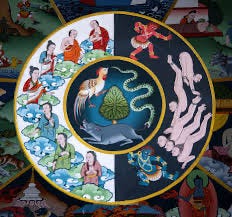
These twelve links are visually mapped out on the outer rim of the traditional Wheel of Life (Bhavachakra) often painted on the walls of Tibetan monasteries.
The Path to Liberation
The liberating truth of dependent origination is that because suffering arises dependently on conditions, it can be dismantled. If you break any link in the chain—most commonly by eliminating ignorance through the realization of emptiness—the subsequent links cannot arise, thereby freeing the practitioner from cyclic existence.