Saraha

Saraha (c. 8th century CE) was a foundational Indian Buddhist Mahasiddha (great sage) and poet, credited as a pioneer of the Sahajayāna (natural way) path and a key figure in Vajrayāna Buddhism, particularly Mahāmudrā. Known as "The Arrow Maker" or "The Great Brahmin" he taught a direct, non-dual approach to experiencing the nature of the mind.
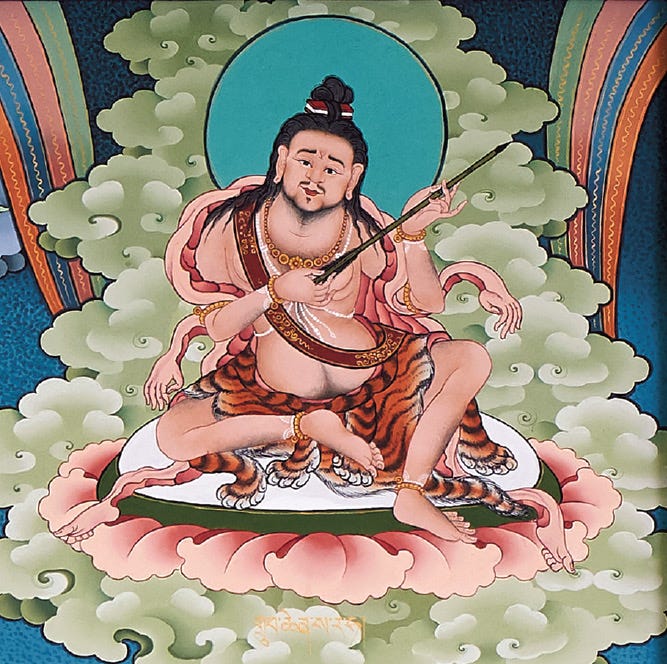
Key details about Saraha include:
Background: Born to a Brahmin family in Eastern India, he was a scholar at Nalanda University before becoming a wandering yogi.
The "Arrow" Symbolism: His name means "one who has shot the arrow" symbolizing his ability to shoot the "arrow of non-duality into the heart of duality".
Teachings: He advocated for "naturalness" and direct experience over rigid doctrine or ritual. His teachings are preserved in Dohākosa (couplets/songs), such as the "Three Cycles of Dohas".
Consort/Teacher: Saraha was significantly influenced by a low-caste woman—often described as an arrow-smith or a radish-curry cook—who served as his teacher and a "mother guru" in Tantric traditions.
Iconography: He is depicted as an elderly, long-bearded man, often in lay clothes, holding an arrow or looking down its shaft.
Note: Saraha is sometimes confused with other figures, but he is fundamentally a pioneer of the Mahamudra tradition within Buddhism, not a modern teacher
@Jack Lhasa @Gabriel Solomon @Charles Minguez
Love these posts. Makes me want to look into Sahara more. Natural teaching is something I've been thinking about a lot 🖤