Yab-Yum

In Tibetan Buddhism, yab-yum (literally "father-mother") is a symbolic representation of a male deity in sexual union with his female consort. It illustrates the primordial, inseparable union of wisdom (the female aspect, or prajna) and compassion or skillful means (the male aspect, or upaya) required to achieve enlightenment.
Key Symbolic Meanings
Transcending Duality: The embrace visually breaks down the illusion of opposites (e.g., self/other, mind/body, masculine/feminine) to realize a state of ultimate wholeness.
The Male Deity (Yab): Represents active compassion, skillful action, and the physical mastery of Buddhist practices.
The Female Deity (Yum): Represents profound, passive insight into the ultimate empty nature of reality.
Bliss and Emptiness: The union represents the ecstatic bliss that arises when one fully understands the empty, ever-changing nature of the universe.
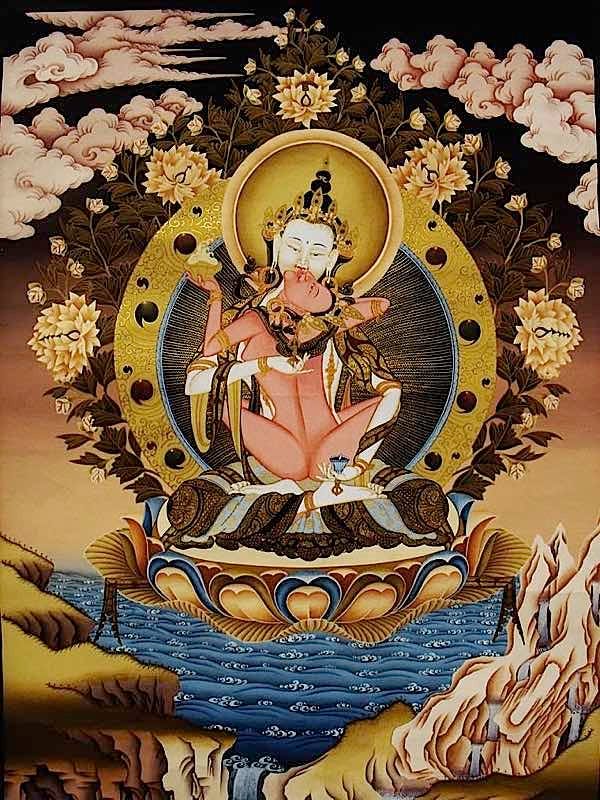
Meditative & Esoteric Context
Yab-yum imagery is primarily associated with Vajrayana (Tantric) Buddhism and is prominent on thangkapaintings and ritual statues. It is generally not intended as a literal sexual practice for the general public, but rather as an advanced meditative tool. Practitioners use the imagery to internalize these divine qualities into their own minds and subtle energy systems.
Thank you for sharing this! There’s a lot of confusion surrounding tantra, especially the sexual imagery and the idea that it’s a sexual practice. I was happy to see you include that it’s not a literal practice.
Another great post.
@Charles Minguez